10
OCT
2026
Le Jardin Extraordinaire in Sri Lanka: Behind RTBF’s 2026 Wildlife Documentary
Read Article

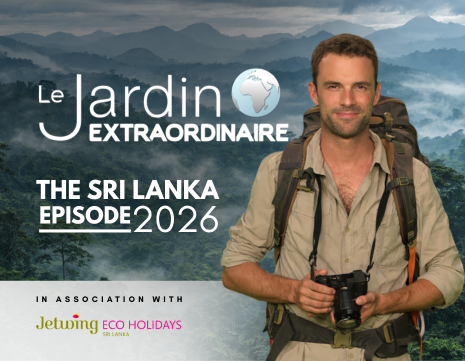
In early 2026, Belgian public broadcaster RTBF returned to Sri Lanka to film a new wildlife-focused edition of its long-running nature programme, Le Jardin Extraordinaire.
Over the course of the production, presenter and wildlife filmmaker Tanguy Dumortier and the RTBF team travelled through four remarkably different Sri Lankan wildernesses: Wilpattu National Park, Udawalawe National Park, the Sinharaja rainforest and Kumana National Park.
Working alongside the production throughout the journey was Jetwing Eco Holidays, the official accommodation and travel partner for the television crew, with Jetwing Eco Holidays wildlife specialist Chandika Jayaratne joining Tanguy in the field as a local wildlife expert.
But facilitating a wildlife documentary requires considerably more than moving a film crew between national parks.
It requires knowing where to look, when to be there, who to speak to, how animals are likely to behave, what a cinematographer needs from an encounter and when an unexpected moment deserves to become part of the story.
The 2026 Le Jardin Extraordinaire production would draw on all of these things as the crew set out to document a side of wild Sri Lanka that extends well beyond its most familiar images.
Production: Le Jardin Extraordinaire
Broadcaster: RTBF, Belgium
Presenter: Tanguy Dumortier
Filming: 2026
Sri Lankan wildlife specialist: Chandika Jayaratne, Jetwing Eco Holidays
Official accommodation and travel partner: Jetwing Eco Holidays
Principal wildlife locations: Wilpattu National Park, Udawalawe National Park, Sinharaja and Kumana National Park
Festival premiere: 10 October 2026, Namur International Nature Festival, Belgium
RTBF television broadcast: Scheduled for November 2026
For French-speaking Belgian audiences, Le Jardin Extraordinaire is an institution.
First broadcast on 3 October 1965, it is Belgium’s longest-running television programme and one of Europe’s longest-established nature programmes. In 2025, Le Jardin Extraordinaire celebrated its 60th anniversary on RTBF, Belgium’s French-language public broadcaster.
Over those decades, the programme has evolved alongside the way wildlife itself is presented on television. What began in an era when animals were sometimes physically brought into the studio gradually developed into a programme increasingly concerned with animals in their natural environments, conservation and original field productions.
Presenter Tanguy Dumortier, who took over the programme in 2014, came to the role with experience both in journalism and wildlife documentary filmmaking. At the heart of the modern programme is a simple philosophy: inspiring people to care about nature by first allowing them to marvel at it.
Sri Lanka was not entirely new territory for the programme either.
In February 2016, an RTBF team travelled to the island to produce a Sri Lankan feature for Le Jardin Extraordinaire. Sri Lanka Tourism records that the resulting programme was first broadcast later that year.
A decade later, the team returned.
This time, the objective was to look more deeply into Sri Lanka’s wildlife and the landscapes, people and stories surrounding it.
On arrival in Sri Lanka, the RTBF crew was welcomed by the Jetwing Eco Holidays team before travelling to Colombo.
The production began with a press event marking the collaboration between RTBF, Jetwing Eco Holidays and the Sri Lanka Tourism Promotion Bureau, before attention quickly shifted from introductions to the practical realities of the journey ahead.
Cameras, lenses, recording equipment and the considerable amount of gear required for a multi-location wildlife production were prepared and checked.
There would be little time to ease into the assignment.
Very early the following morning, the RTBF crew and representatives of Jetwing Eco Holidays left Colombo and headed directly north towards their first wilderness: Wilpattu National Park.
Wilpattu provided the production with its first intensive period in the field.
The crew would spend four full days exploring the national park, often remaining out for long periods to maximise filming opportunities.
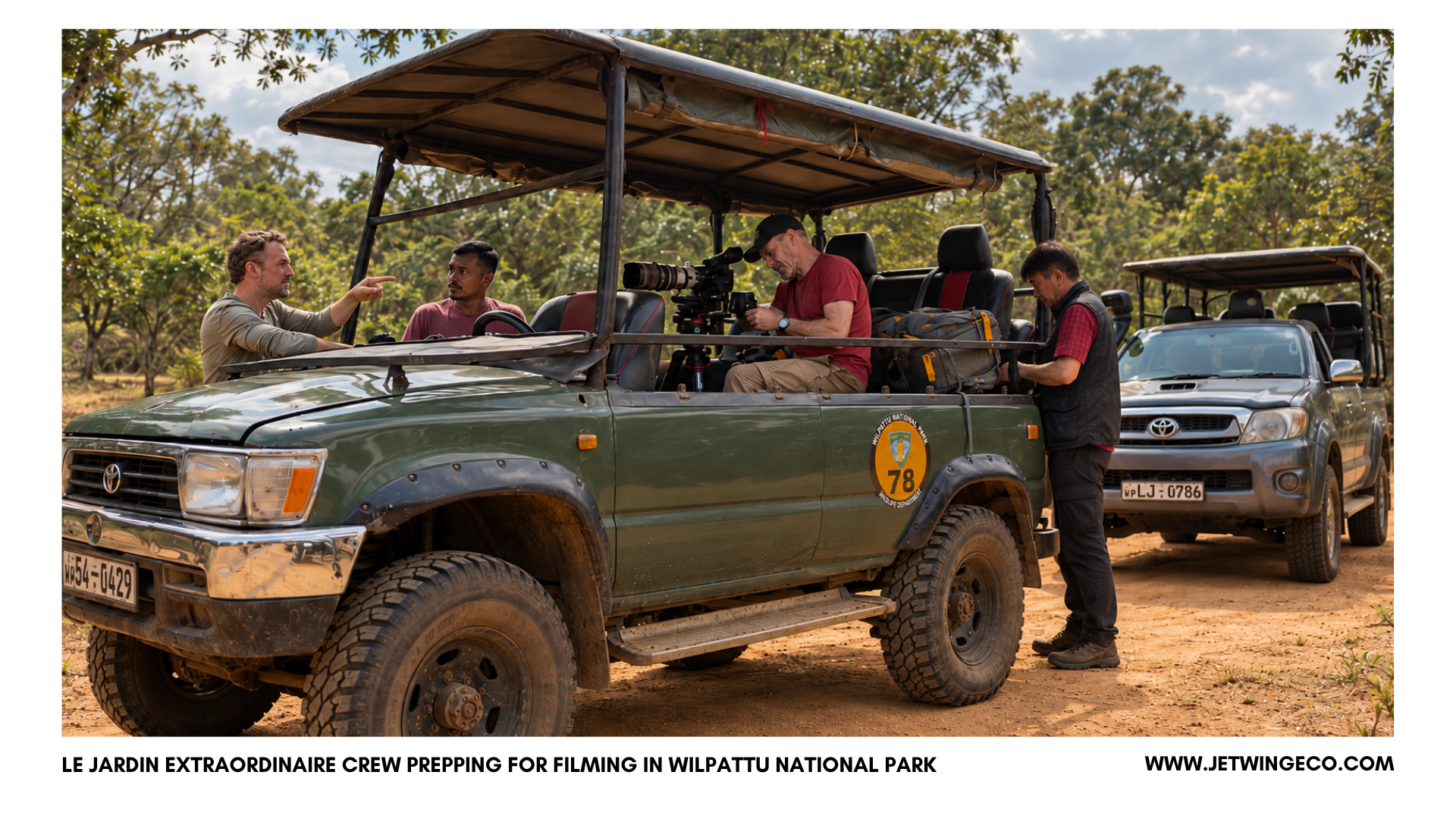
For this stage of the journey, two safari vehicles performed very different jobs.
The principal camera vehicle was an early-1990s Toyota Hilux pickup modified for wildlife photography and cinematography. Its original roof had been removed and replaced with open passenger seating, a protective framework and canopy, giving camera operators far greater visibility and freedom of movement.
A second, newer Toyota Hilux Smart Cab acted as the support vehicle, carrying supplies while also providing another set of eyes searching the forest for wildlife.
For a conventional safari, seeing an animal may be enough.
For a documentary crew, the direction of travel, available light, background, viewing angle and the animal’s next movement can determine whether a sighting becomes usable footage.
Wilpattu provided many of the subjects the crew had hoped to find.
There were raptors, kingfishers and owls, solitary elephants moving through the forest and an unusually relaxed jungle cat that allowed the team a rare opportunity to observe and document a species that is often considerably less obliging.
Yet one of the most intriguing stories developed around a far smaller animal.
At the entrance to Wilpattu is a Buddhist shrine where clay oil lamps are traditionally lit beneath the Buddha image. Wildlife Department personnel and visitors may light the lamps while seeking blessings and a safe journey.
Here, the crew noticed a squirrel that appeared to have learned to take advantage of the ritual.
The animal would wait near the shrine until the flame of a lamp had gone out before approaching and nibbling at the burnt cloth wick, which remained soaked with coconut oil.
For the filmmakers, it was irresistible.
A seemingly ordinary squirrel had found a way to interact with a distinctly human tradition, creating a small story where wildlife and Sri Lankan culture met in the same frame.
The production also filmed a sequence in which Tanguy Dumortier and Chandika Jayaratne visited the shrine before entering the park, lighting an oil lamp before climbing into the safari vehicle and heading into the wilderness.
It was an early reminder that some of the most memorable natural-history stories are not necessarily the ones written into a production schedule.
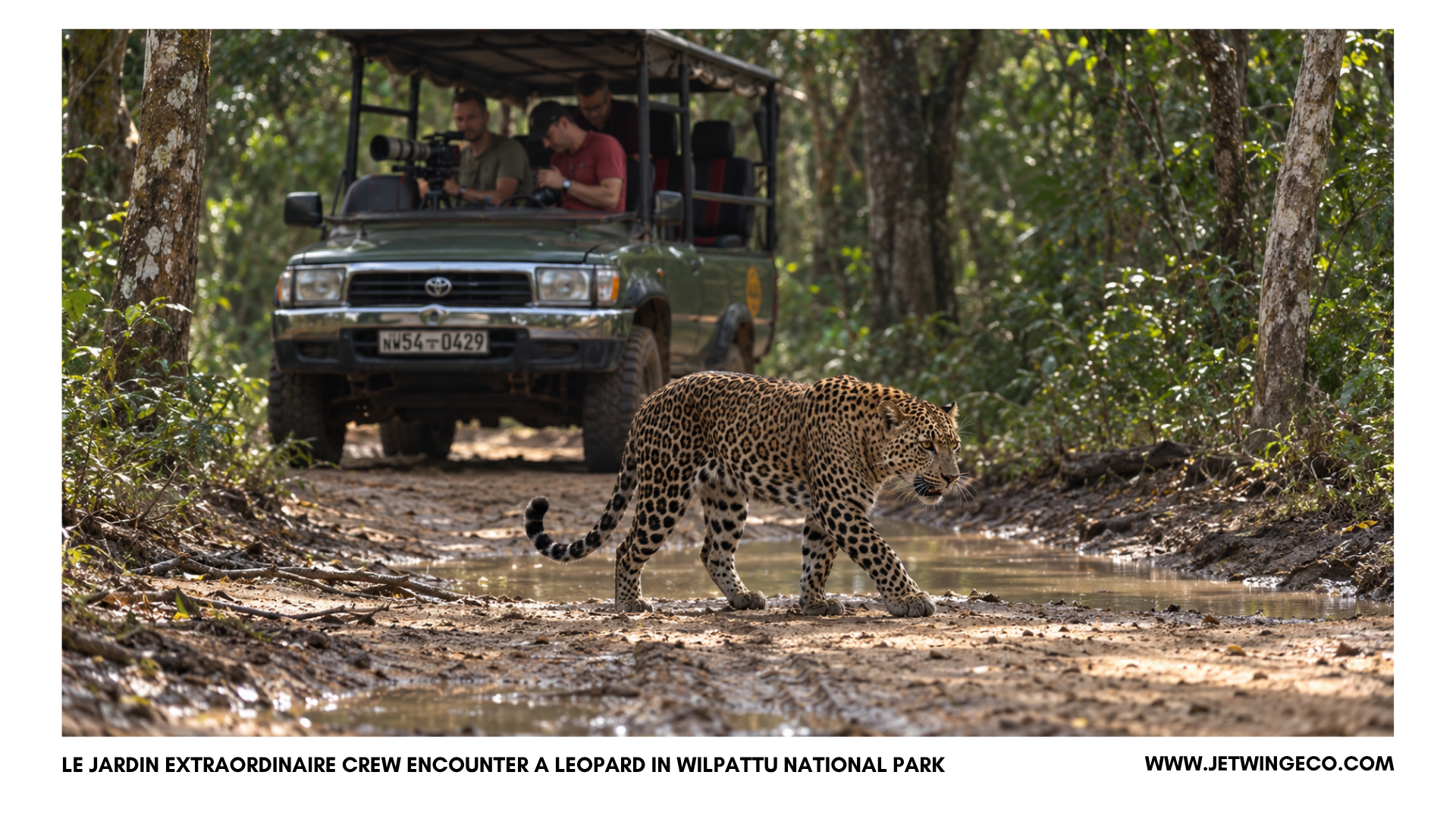
The defining wildlife encounter of the Wilpattu leg came in the form of a mature male Sri Lankan leopard.
Known locally as Neluma, after Nelumwila, the area of Wilpattu associated with his early life, he appeared on a narrow forest road ahead of the camera vehicle.
The leopard was travelling in the opposite direction.
Rather than turning away, Neluma continued confidently towards the stationary crew, passed around their vehicle with little hesitation and continued along the track behind them.
Once the leopard had passed, the camera vehicle repositioned at a respectful distance.
The resulting encounter developed into an extraordinary formation.
Neluma walked steadily along the forest road. The support vehicle remained ahead of him, reversing when necessary to maintain distance and avoid obstructing his path, while the camera vehicle followed behind.
For approximately five minutes, the RTBF crew was able to document a mature Sri Lankan leopard simply moving through his environment.
There was no need to manufacture drama.
Eventually, Neluma turned from the track and disappeared into the forest.
The encounter illustrated an important difference between ordinary wildlife viewing and natural-history filmmaking.
It is not simply about reaching an animal first. It is about reading its movement, anticipating what may happen next, positioning cameras without interfering with its path and allowing the encounter to unfold on the animal’s terms.
Wilpattu also produced several prolonged encounters with Sri Lankan sloth bears.
During one particularly memorable sighting, a bear emerged from the roadside vegetation and crossed the forest track between the safari vehicles before continuing calmly into the vegetation on the opposite side.
Wildlife rarely follows a shot list.
For a film crew, moments such as this demand readiness, patience and enough understanding of animal behaviour to know when remaining still is more useful than trying to reposition.
The Wilpattu chapter concluded from an entirely different perspective.
Drone operations within and around protected areas are subject to regulation in Sri Lanka, and the Civil Aviation Authority of Sri Lanka operates an approval system that identifies restricted and authorisation zones.
With the necessary permissions secured, Jetwing Eco Holidays facilitated aerial filming from the lush buffer-zone landscape surrounding Wilpattu.
The camera followed the crew’s safari vehicle travelling through wooded terrain, past grasslands and water, before climbing above the landscape to reveal Wilpattu from a bird’s-eye perspective.
From above, one of the park’s defining natural features becomes particularly clear: its villus.
Wilpattu’s villus are natural shallow basins and wetlands formed within the landscape, some seasonal and others more permanent. Together with their surrounding grasslands, they are considered one of the national park’s outstanding ecological features.
Seen from the air, the villus, forest canopy, open ground and exposed rock formations formed a tapestry across the wilderness.
Sometimes documenting wildlife means finding an animal.
At other times, telling its story requires understanding the landscape that makes its existence possible.
From Wilpattu, the production turned south towards a very different kind of elephant country.
Although Udawalawe National Park would return the crew to Sri Lanka’s dry country, visually it could hardly have felt more different from Wilpattu.
The mature forest, enclosed tracks and scattered villus gave way to a broader landscape of scrub, grassland, scattered woodland and the enormous presence of the Udawalawe Reservoir.
Along its banks, waterbirds share the landscape with one of the park’s most recognisable inhabitants: the Asian elephant.
The production spent two full days inside Udawalawe.
At one designated rest area, a broad and relatively flat rock outcrop allowed the crew to leave the safari vehicles and climb above much of the surrounding vegetation. From its summit, the team could look across the national park, gaining an elevated perspective over the treeline and the open terrain beyond.
But the reservoir margins produced the principal wildlife story.
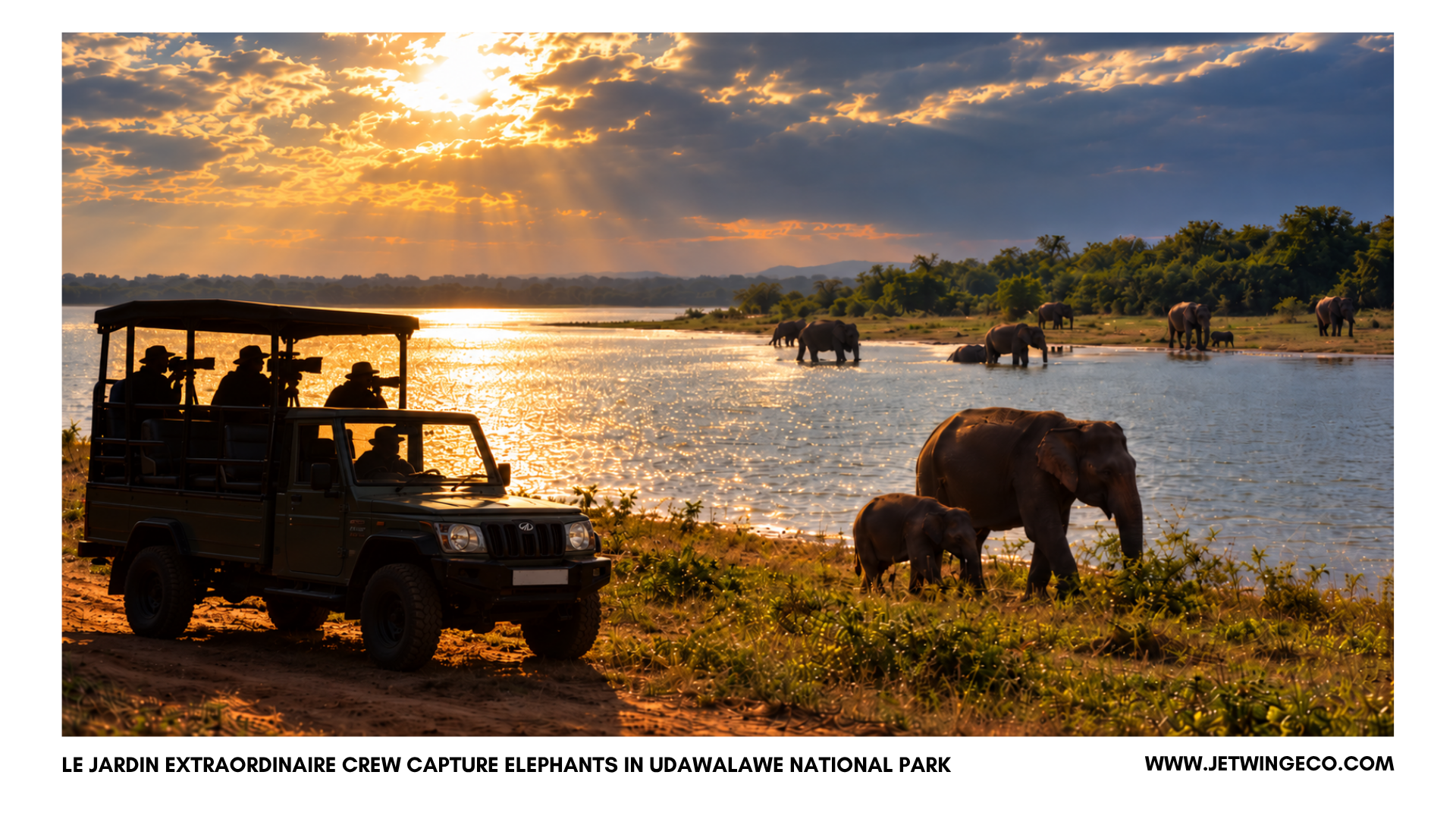
The crew documented family groups grazing close to the water, mothers travelling beside their calves and young elephants displaying the playful behaviour characteristic of juveniles.
Then a large male emerged from the scrub.
The bull was in musth, a physiological state in mature male elephants associated with elevated reproductive hormones and often far more assertive behaviour.
Another large male was nearby.
The musth bull approached, making his intentions clear enough that the second elephant chose to retreat rather than escalate the encounter.
Still visibly stimulated, the first bull eventually entered the reservoir.
There, the tone of the scene changed completely.
The elephant drew water into his trunk and sprayed it across his enormous body, creating the kind of sequence wildlife filmmakers hope for: behaviour, movement, habitat and light converging at the same moment.
An elephant is enormous. It might therefore seem like an easy subject for a camera.
In practice, filming elephants well presents its own technical challenges.
Their grey skin is made up of folds, wrinkles and broad surfaces that react dramatically to changing light. Harsh overhead sunlight can produce deep shadows while simultaneously flattening other areas of the animal’s body. At the opposite extreme, insufficient light can cause much of the texture that gives an elephant its visual character to disappear.
For the RTBF production, finding elephants was therefore only part of the equation.
Time of day, direction of light, the elephant’s position relative to the sun, surrounding vegetation and the background of the shot all became important considerations.
A good wildlife sighting and a good wildlife image are not always the same thing.
Before departing, and with the relevant approvals in place, the team also captured aerial footage showing the reservoir and its surrounding landscape.
Where Wilpattu’s aerial imagery revealed many individual wetlands woven through forest, Udawalawe was defined by the scale of a single vast body of water and the open habitats surrounding it.
The next destination would change the production’s approach completely.
The cameras were heading into the rainforest.
The journey towards Sinharaja brought narrower roads, winding hills, mist and increasingly dense vegetation.
Sinharaja Forest Reserve represents Sri Lanka’s last viable expanse of primary tropical rainforest and supports exceptional levels of endemism, particularly among birds. UNESCO records 19 of Sri Lanka’s endemic bird species within the World Heritage property.
But what makes Sinharaja extraordinary for a birder can also make it difficult for a cinematographer.
Small subjects, dense vegetation and a high rainforest canopy present very different challenges from filming elephants beside a reservoir or a leopard on a dry-zone forest road.
The change begins before entering the forest.
Sri Lanka’s dry-zone national parks are dominated by relatively modern Japanese and Indian-built four-wheel-drive pickups.
Around Sinharaja, the vehicles serving the steep birding trails have developed an identity of their own.
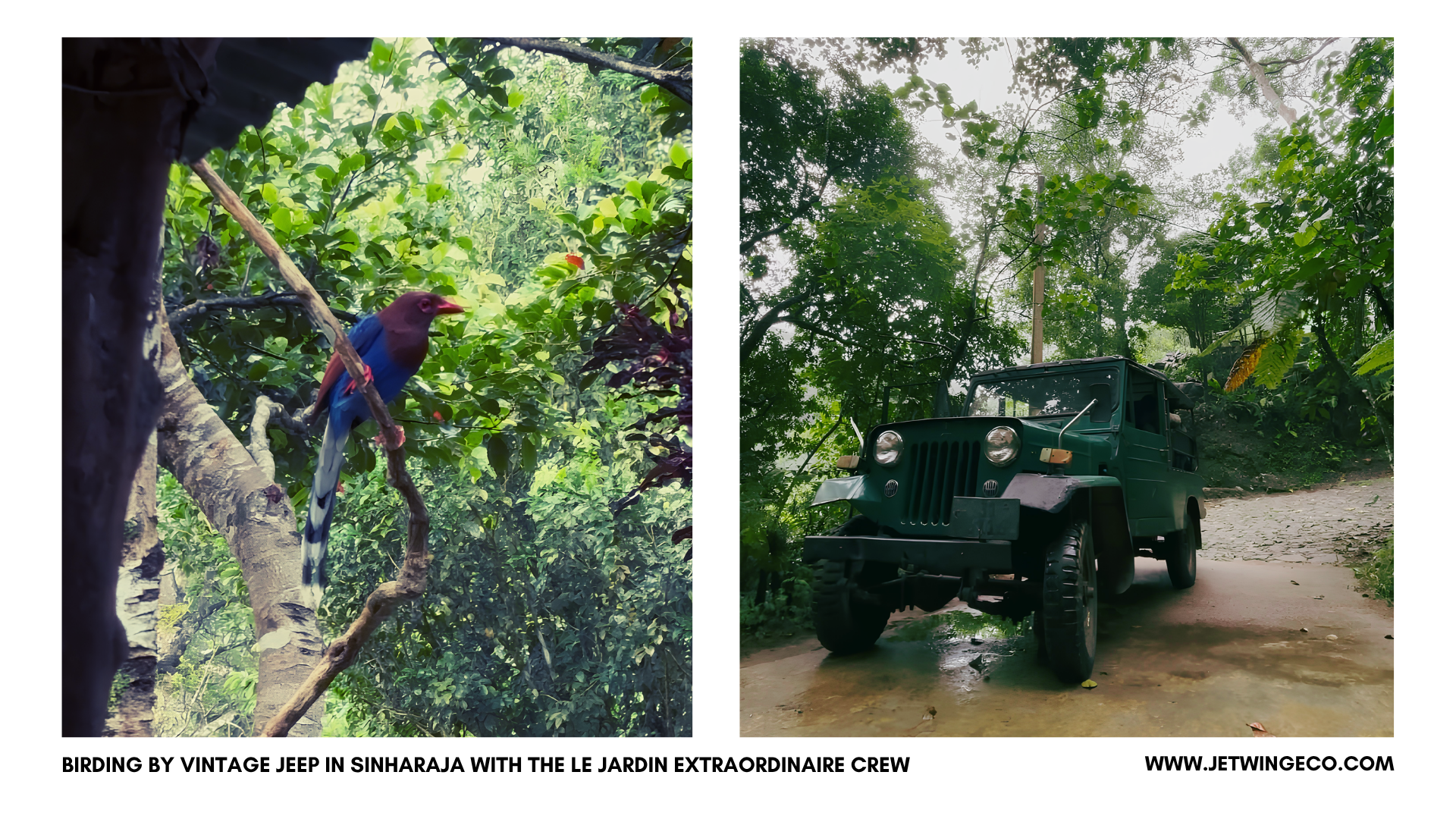
A small local fleet consists of several vintage Mitsubishi Jeeps, two Willys Jeeps and a Land Rover Defender, kept operating by a close-knit community of drivers through years of repairs, adaptation and the use of Japanese replacement parts.
Their small dimensions and four-wheel-drive capability are particularly well suited to the steep, narrow tracks climbing through the rural communities surrounding the rainforest.
The RTBF team travelled in one of the vintage Mitsubishi Jeeps, driven by Tilak, a local driver and experienced birding guide.
Inside the protected rainforest, where vehicles cannot simply follow wildlife through the forest as they might in a national park, another problem quickly becomes apparent.
A skilled birder using binoculars may be able to identify a bird moving high through Sinharaja’s canopy.
A documentary camera needs considerably more.
Branches, leaves, shadows and layers of vegetation constantly interrupt sightlines. A bird may be clearly visible to the human eye yet offer only seconds of unobstructed footage through a long lens.
For that reason, the production also worked through the village and forest-edge landscape surrounding Sinharaja, drawing on local knowledge to identify locations where endemic birds could be observed under more favourable filming conditions.
Tilak guided the team between established birding locations around the hills, including sites close to rural homes and small village properties, as well as locations where viewing areas and feeding points provided opportunities to wait patiently for birds to appear.
Across the following days, endemic species began appearing one after another.
The spectacular Sri Lanka Blue-Magpie, the secretive Sri Lanka Spurfowl and the endemic Sri Lanka Grey Hornbill were among the birds photographed and filmed.
The cameras also found a purple-faced langur moving through the treeline, adding one of Sri Lanka’s endemic primates to the production.
Then came one of Sinharaja’s most rewarding finds.
The Sri Lanka Frogmouth is almost designed to avoid being noticed.
Nocturnal and extraordinarily well camouflaged, it spends much of the daylight sitting almost motionless among shaded branches and dense vegetation. Its mottled plumage can make the outline of the bird virtually disappear among bark, leaves and shadow.
Finding one by chance is difficult.
Finding one in a position where a professional film crew can obtain clear footage is another challenge entirely.
Tilak’s persistence and knowledge of the area eventually delivered exactly what the production needed.
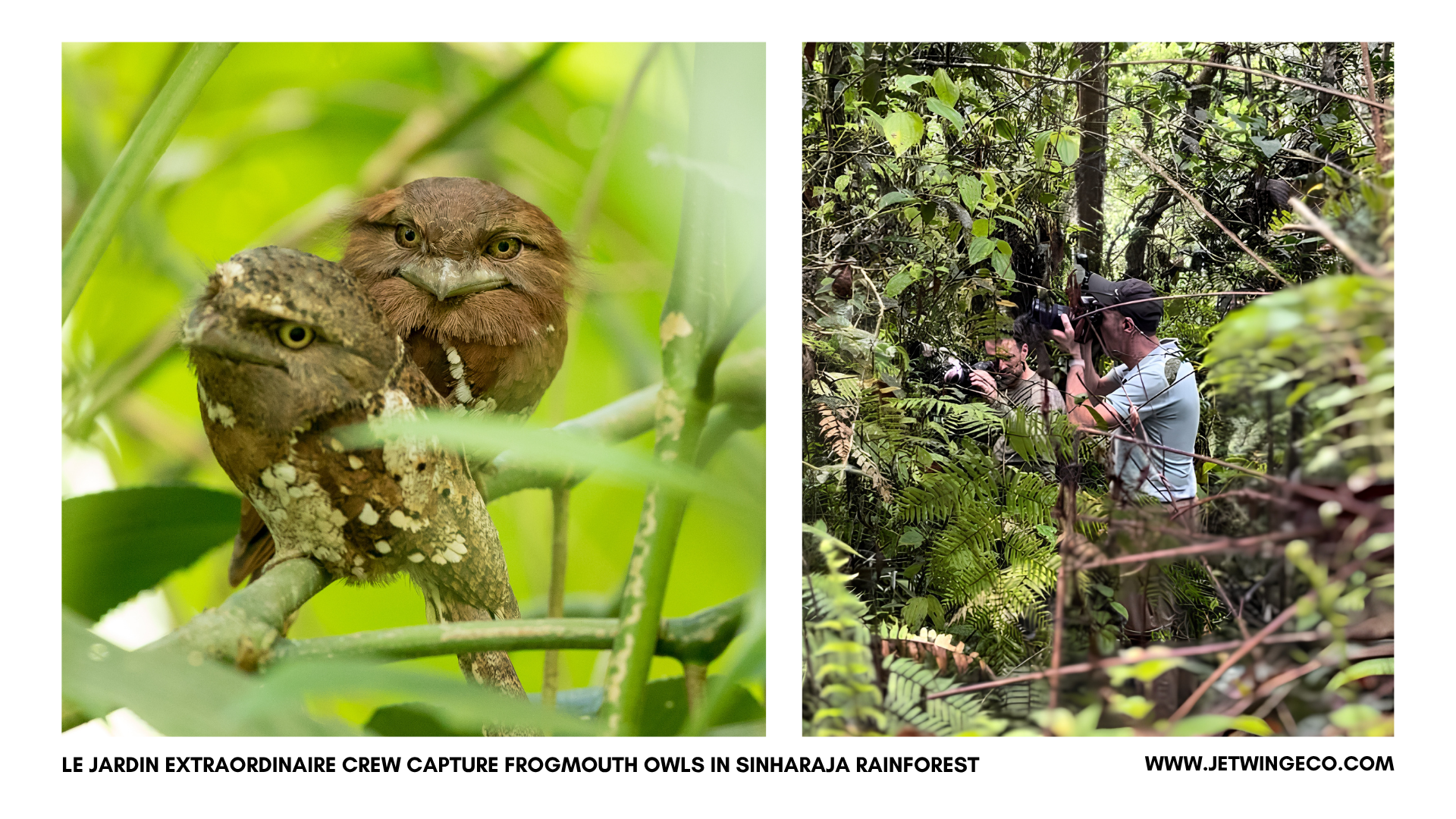
In a cool, heavily shaded pocket of vegetation, surrounded by brush and trees, he located a pair of Sri Lanka Frogmouths roosting closely together on a branch.
The crew carefully found filming positions through the surrounding vegetation and documented the resting pair without needing to manufacture the encounter.
It was a considerably smaller subject than the elephants of Udawalawe or the leopards of Wilpattu.
Yet in many ways, it demonstrated the value of local wildlife expertise even more clearly.
A leopard on a forest road, an elephant beside a reservoir and a frogmouth concealed in rainforest vegetation require three completely different approaches.
In Sinharaja, successful filming depended on understanding the birds, the surrounding village landscape, likely birding locations, the limitations created by the canopy and, critically, knowing the people who understand the forest well enough to interpret all those variables in the field.
Supporting a wildlife documentary is not simply about taking a crew somewhere that animals are known to occur.
It is about creating the circumstances in which a story can actually be filmed.
After three days among the rainforest hills, the production crossed Sri Lanka once more.
Its final wilderness lay in the east.
Kumana National Park returned the team to dry-zone wilderness, yet once again the landscape had its own identity.
Lagoons, wetlands, tanks and watering holes punctuate its forests and open country, making Kumana particularly celebrated for its birdlife.
But birds are only part of the story. Elephants move through its forests. Sloth bears remain hidden within the vegetation. Crocodiles inhabit its waters.
And then there are the leopards. Kumana’s leopards have acquired an almost legendary reputation among the relatively small number of wildlife enthusiasts who spend time in the park.
Yet Kumana remains markedly less frequented than Sri Lanka’s busiest safari destinations.
For a wildlife film crew, that relative solitude can be invaluable.
Part of Kumana’s quietness is explained by access.
The village of Panama, approximately 30 minutes north of the park entrance under normal conditions, offers a limited selection of simple lodges and safari accommodation.
To provide the RTBF crew with greater comfort after long filming days, the production was instead based around Pottuvil, which meant travelling for roughly an hour or more before reaching the national park entrance.
The consequence was simple.
Sunrise filming required very early mornings.
But Kumana rewarded the effort.
Arriving as the first light began illuminating its wetlands, forest and open country gave the crew long periods in which there were few other vehicles around them.
Wildlife filming often benefits from exactly that commodity: time without interruption.
The quiet landscape also created opportunities for sequences that were about more than simply recording animals.
Deep inside Kumana, with wildlife and wilderness surrounding them, Tanguy Dumortier and Chandika Jayaratne were able to film discussion-style segments exploring what the crew was seeing and what made Sri Lanka’s wildlife exceptional.
Rather than taking place in a studio or against an artificial backdrop, these conversations unfolded within the habitat itself.
It allowed the programme to move beyond a succession of sightings and interpret the larger story: how wildlife, landscape and people are connected across Sri Lanka.
One of the final great wildlife encounters of the journey arrived shortly before sunset.
A Sri Lankan leopard was found resting on the branch of a tall, mature tree.
Unlike Neluma’s purposeful walk along the Wilpattu forest track, this leopard offered a completely different cinematographic opportunity.
The animal remained settled above the ground while the evening light changed around it.
As sunset approached, the Kumana sky began taking on increasingly fiery colours, placing the leopard, the old tree and the changing landscape within the same scene.
In Wilpattu, successful filming had depended on responding to a moving animal.
In Kumana, it depended on patience.
The cameras could remain trained on a stationary leopard while natural light transformed everything around it.
It became one of the defining visual moments of the final leg.
Kumana would also provide the setting for the documentary’s conclusion.
Within the vast and green buffer-zone landscape around the national park, a large exposed rock formation rises above the surrounding vegetation.
It offered the crew the viewpoint they had been looking for.
With the necessary approvals secured, the final sequence combined the people who had made the journey with the wilderness they had spent weeks documenting.
Tanguy Dumortier, the RTBF crew and Chandika Jayaratne of Jetwing Eco Holidays stood together at the top of the rock.
Then the drone pulled away.
What began as a group of people against the skyline became smaller and smaller as the aerial camera revealed the scale of the landscape surrounding them.
Forest, open country and distant horizons gradually became the dominant subjects.
It was an appropriate way to end a production that had spent its journey doing much the same thing: placing people within Sri Lanka’s natural world rather than treating nature simply as a backdrop.
The filming was complete.
The RTBF team returned to Colombo following the final days in Kumana.
There was time for a night’s rest, but also for one of the least glamorous and most important parts of any documentary expedition: organising equipment and ensuring that the considerable volume of footage gathered across Sri Lanka was safely accounted for.
The following day, the crew departed for Belgium.
Post-production began soon afterwards.
On 10 October 2026, the resulting Sri Lankan wildlife documentary received its inaugural public screening at Le Delta in Namur, Belgium, as part of the Namur International Nature Festival.
More than 400 nature enthusiasts, conservationists and biodiversity lovers attended the screening. Tanguy Dumortier subsequently joined a discussion about Sri Lanka’s wildlife and natural heritage. The documentary is scheduled for television broadcast on RTBF in November 2026.
For Jetwing Eco Holidays, seeing the production reach an international audience represented the culmination of a journey that had begun long before the first camera entered Wilpattu.
Across four locations, the requirements of the production changed repeatedly.
In Wilpattu, wildlife filmmaking meant understanding forest tracks, leopard and sloth bear behaviour, specialist safari vehicles, camera positioning and the network of villus that gives the landscape its identity.
In Udawalawe, attention shifted to elephants, reservoir habitats, open landscapes and understanding how light interacts with one of the world’s largest land mammals.
In Sinharaja, the challenge became finding and filming small, cryptic animals through dense vegetation, drawing on the expertise of local bird guides and the knowledge embedded within communities around the rainforest.
And in Kumana, remoteness and lower visitor numbers created logistical challenges while simultaneously providing the solitude, wildlife and expansive landscapes that make natural-history filmmaking possible.
Then there are the requirements that connect them all: accommodation, transport, equipment, permissions, aerial filming, early starts, changing weather, specialist guides, local relationships and the constant need to adapt when wildlife does something completely unexpected.
This is where wildlife knowledge becomes production knowledge.
A successful wildlife production depends not simply on knowing that a species occurs somewhere in Sri Lanka, but understanding where to look for it, how it uses the landscape, when conditions are likely to be favourable and what a photographer or cinematographer actually needs in order to document it.
Some of the most valuable moments of the journey were not necessarily the most obvious ones.
A famous male leopard walking confidently along a Wilpattu forest track.
A squirrel waiting beside a Buddhist shrine for the opportunity to eat an oil-soaked lamp wick.
A bull elephant cooling itself in the Udawalawe Reservoir.
A pair of Sri Lanka Frogmouths almost disappearing into the shadows around their roost.
A leopard resting in an old tree while the Kumana sky turned orange behind it.
Each told a different story.
Together, they demonstrated something that has always shaped the way Jetwing Eco Holidays approaches wildlife in Sri Lanka.
The island’s natural history is bigger than a checklist of famous species and bigger than its most visited national parks.
Its stories exist within forests, wetlands, villages, lagoons, mountains, coastlines and the communities living beside them.
Finding those stories requires local knowledge.
Telling them requires patience.
And documenting them well requires understanding both the wildlife in front of the camera and the needs of the people behind it.
The Le Jardin Extraordinaire production represents one example of Jetwing Eco Holidays’ work with international filmmakers, photographers and media teams seeking to document Sri Lanka’s wildlife, landscapes and authentic culture.
For a production team, this can mean identifying suitable wildlife locations, working with specialist naturalists and local guides, planning around target species and seasonal conditions, arranging appropriate vehicles and accommodation, supporting filming logistics and helping navigate the practical requirements of working across remote parts of Sri Lanka.
For a professional photographer, it may mean something different: designing an itinerary around light, subject behaviour, shooting positions, time in the field and the opportunity to return repeatedly to promising locations.
And for the wildlife traveller, the same network of knowledge can be used to create a journey around something very simple:
What do you want to see?
A particular leopard landscape. An endemic bird. A nocturnal mammal. A flying-fox colony. Reptiles and amphibians. Elephants away from the busiest safari circuit. A rainforest species that requires somebody who knows exactly where to start looking.
Sri Lanka contains an extraordinary concentration of wildlife within a relatively small island.
Jetwing Eco Holidays’ role is to help unlock it.
Deep relationships with naturalists, researchers, guides, drivers and communities around the country’s wild places allow us to look beyond the standard itinerary and ask a different question:
What story do you want Sri Lanka to reveal?
Jetwing Eco Holidays provides specialist ground support for wildlife-focused filming and photography projects in Sri Lanka, drawing on local wildlife knowledge, naturalist expertise, field logistics and relationships with people working in and around the island’s wilderness areas. The 2026 RTBF Le Jardin Extraordinaire production is one example of this capability.
The principal wildlife locations covered during the production were Wilpattu National Park, Udawalawe National Park, the Sinharaja rainforest and Kumana National Park.
Chandika Jayaratne of Jetwing Eco Holidays joined presenter Tanguy Dumortier in the field and appears in the documentary as a local wildlife specialist.
Yes. Specialist photography programmes can be built around target wildlife, locations, light, field time and the specific requirements of photographers rather than following a conventional sightseeing itinerary.
That is precisely where specialist local knowledge becomes valuable. Depending on season, habitat and the target animal, Jetwing Eco Holidays can design wildlife journeys around particular species or groups, drawing on naturalists, researchers, experienced guides and local communities to identify the strongest realistic opportunities.
Yes. Sri Lanka’s natural and cultural stories frequently overlap. Rural communities, traditional livelihoods, researchers, conservation projects and people living alongside wild landscapes can form an important part of documentary, photographic and specialist travel programmes where appropriate.
Whether the objective is a natural-history documentary, professional photography expedition, wildlife videography project or a deeply specialised wildlife holiday, the starting point does not have to be a standard itinerary.
Tell us the species, landscape, behaviour or story you hope to find.
Then let Sri Lanka do the rest.